
Reviewed · UYUNI SALT FLAT TOURS
Salt Flat Uyuni from Uyuni
Salar de Uyuni is the main event, a white plain stretching across 10,582 square kilometers at 3,650 meters above sea level. This $100 day trip packs the classic sights into eight hours, with a 4×4, lunch, a driver-guide, and pickup or drop-off at Uyuni’s main plaza or bus terminal.
I like the route for two clear reasons: Incahuasi Island adds giant cacti and Inca-era culture to the salt experience, and the stop at Colchani gives you a look at local salt crafts instead of rushing straight into the desert. The main caution is communication. English is offered, but Carlos and Christopher have not always spoken it fluently, and pickup instructions have caused confusion for some passengers.
Key points to know before booking
- The salt flat is only one part of the day: You also visit the train cemetery, Colchani, and Incahuasi Island.
- A 4×4 is essential: The vehicle handles the long stretches between Uyuni’s stops and the salt flat.
- Incahuasi costs extra: The island entrance is Bs 30, not included in the tour price.
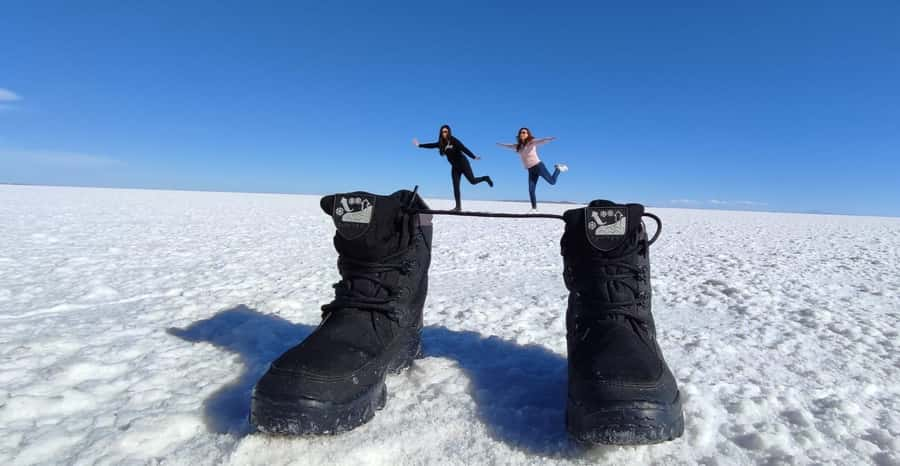
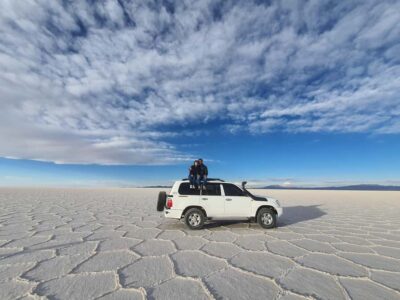
- Photo help is part of the appeal: Your guide can suggest playful perspective shots and good places to use the wide white surface.
- Rain changes the experience: Wet salt can create striking reflections, but cold, wind, and rain are possible.
- Pickup needs careful planning: Bus station pickup is included, while airport and hotel arrangements should be confirmed directly.
Why this one-day Uyuni route works
A full multi-day salt-flat trip is not possible for everyone. You might be passing through Uyuni by bus, arriving for a short stay, or simply want the famous sights without spending several nights in a remote area. This eight-hour route gives you the standard first taste of the region in one long day.
The order makes sense. You begin with industrial relics near town, then see how local residents use salt today, and finally reach the vast salt plain and its island outcrop. I like that progression because the day is not just a stop-and-photo circuit. It gives you three ways to understand Uyuni: abandoned railway commerce, local craft work, and an enormous natural formation shaped by ancient cultures.
The tour costs $100 per person. That is a fair price if you value an organized 4×4, lunch, and transport between widely separated stops. You would otherwise need to arrange a vehicle and driver yourself, which is the key practical service here. Remember to budget another Bs 30 for Incahuasi Island, plus your own snacks, breakfast, and dinner.
The day is intense. You spend much of it in the vehicle, with short visits at the train cemetery and Colchani and longer time at Incahuasi. If you want slow photography, extended walks, or a sunset-focused outing, this schedule may feel tight.
More salt flat trips running from Uyuni
- Day Trip to Uyuni Salt Flats
★ 4.0 · 602 reviews - 3-Day Tour to Salt Flats and Lagoons
★ 4.5 · 168 reviews - From Uyuni: Red Lagoon & Uyuni Salt Flats 3-Day Guided Tour
★ 4.4 · 160 reviews
Starting in Uyuni: pickup details matter
You can begin at Plaza Principal Aniceto Arce or the Terminal de Buses. Bus station pickup and drop-off are included, which is useful if you are arriving by bus and leaving soon after the tour.
Tell the operator your bus company if you need a terminal pickup. Also give clear arrival details well ahead of time. If you arrive by plane or train, the stated arrangement is to go to the main meeting point rather than assume a direct airport pickup. If you are staying in Uyuni, a hotel pickup may be possible when the hotel is nearby.
This point deserves attention. One departure had an airport pickup problem, with no driver present when expected. I would not leave this to chance. Confirm the exact meeting place, time, and contact method before travel, especially if you are arriving by air.
The vehicle is a 4×4 SUV or jeep. The first drive is only about 15 minutes, but the later stretches are much longer. The trip includes roughly 30 minutes to the train cemetery, 30 minutes onward to Colchani, and about 90 minutes from Colchani to Incahuasi Island.
The train cemetery and Uyuni’s industrial past
The train cemetery comes early, after a short drive from town. You get about 30 minutes to walk among old locomotives and take photographs against the open surroundings.
These trains connect Uyuni with the mineral trade of the late 19th and early 20th centuries. Railway construction was ordered in 1872 toward Antofagasta, Chile, to move copper, tin, silver, gold, sodium nitrate, and other raw materials. When local industry collapsed around the 1940s, the railway equipment was abandoned.
Today, the stop is stark and photogenic. Rusted metal, open sky, and geometric train parts make it an easy place to experiment with angles. You can climb up for photographs, but use care on old machinery and watch your footing.
Thirty minutes is enough for a first look, not a detailed exploration. The stop is exposed, with little shelter, so your jacket and sunglasses should be in your daypack from the start.
Colchani: salt, crafts, and a useful local stop
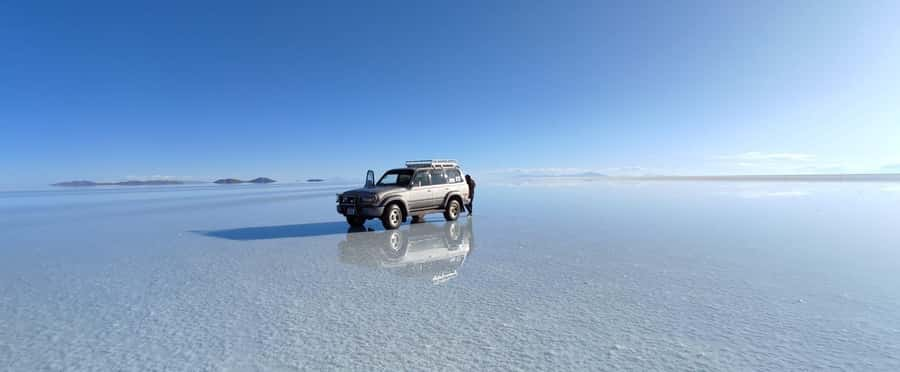
After another drive, you reach Colchani, a small town whose residents make salt crafts, textiles for cold weather, and other goods. You have about 30 minutes to walk around, browse the arts and crafts market, and decide if you want to visit the small salt museum.
This is a brief stop, but it gives the day a human scale. Before you see salt spread across the horizon, you see how it becomes an edible product and a material for local objects. Salt figures and other crafts can make more meaningful souvenirs than generic items sold at a large city market.
The museum is optional, and the schedule does not allow for a long visit. I would treat Colchani as a chance to stretch your legs and buy something if you genuinely like it, not as a major museum visit. Carry cash because small purchases are not guaranteed to accept cards.
A few more trips around Uyuni worth a look
- La Paz: 5-Day Uyuni Salt Flats by Bus
★ 4.3 · 153 reviews - From Uyuni: Salt Flats Highlights Jeep Tour with Lunch
★ 4.8 · 133 reviews - Uyuni: Uyuni Salt Flats and San Pedro de Atacama 3-Day Tour
★ 4.3 · 122 reviews - Uyuni Salt Flats 3 Days/ 2 Nights with English Speaking Guide
★ 4.0 · 91 reviews
Entering the salt flat by 4×4
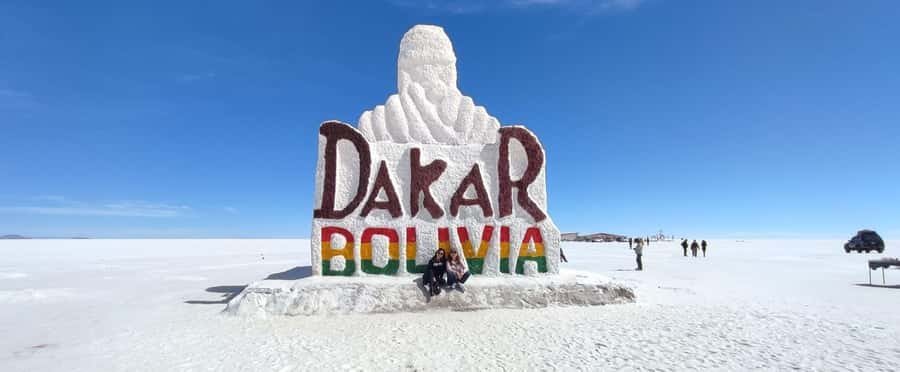
From Colchani, the vehicle takes about an hour and a half to reach the main salt-flat sights. This is where the scale changes. Salar de Uyuni covers 10,582 square kilometers and sits at 3,650 meters above sea level, making it both the world’s largest salt desert and one of the highest.
The surface can look almost blank at first. That is precisely the attraction. The white ground gives you unusual space for photographs, especially when the weather is clear. Your guide can suggest perspective tricks, using distance and scale to make people, objects, and vehicles appear larger or smaller than they really are.
Bring a charged phone or camera, but do not rely on it for the whole day. Cold weather can drain batteries, and bright salt can make screens difficult to read. Sunglasses are not optional in practical terms. The glare can be strong, and the tour information specifically warns you to bring them.
Rain can change the scene. A thin layer of water may create reflective effects and stronger shadows, producing the famous mirror-like photographs. At the same time, rain can make the day colder and less comfortable. The route may be rainy, and conditions can shift between cold and warm, so pack a jacket and rain gear rather than dressing for a dry desert alone.
Incahuasi Island and the giant cacti
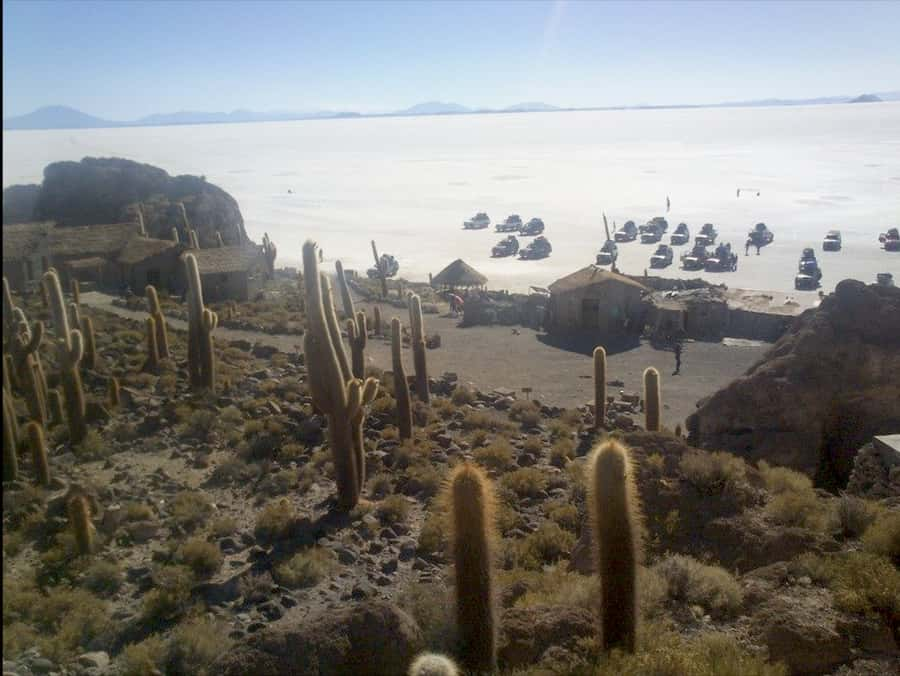
Incahuasi Island is the longest stop, with about two hours for a visit, a picnic, photographs, and views on the way. The island rises from the salt plain and provides a sharp contrast to the flat white surface.
Its giant cacti are the star attraction. You can walk for about 45 minutes, taking in the unusual combination of tall cactus growth, white salt, and distant open space. The island also has an Inca connection and a small museum near the end of the walk, giving the stop more substance than a simple photo break.
The walk is not described as a difficult hike, but the altitude matters. At 3,650 meters, even an easy uphill section can feel harder than expected. Move at a steady pace, drink water, and do not treat the island as a race to the highest point. The tour is not suitable for people with altitude sickness.
The Bs 30 entrance fee is paid separately. Keep local cash ready so you do not have to solve a payment problem at the entrance. Your lunch is included, and the picnic timing makes Incahuasi the practical place to eat.
The island is also where the day can feel most crowded or rushed, depending on how long you spend with lunch, photographs, and the walk. If you care most about cactus photography, tell your guide early. If you prefer the salt plain itself, you may want to preserve energy for the final salt-flat stops.
The salt museum, old salt hotel, and salt-flat details
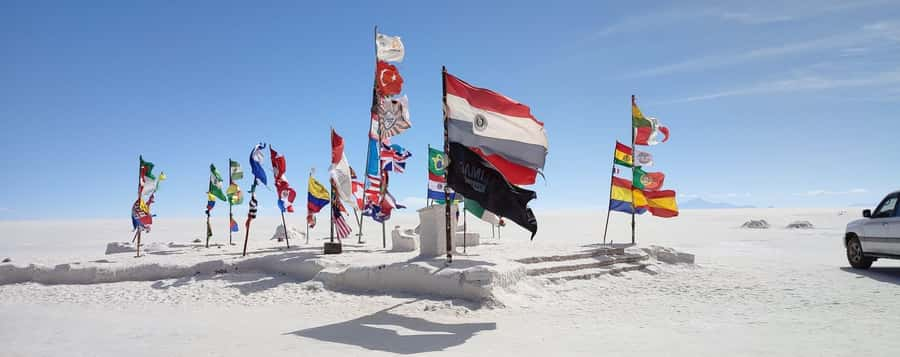
The route includes salt piles and salt sculptures, as well as a former hotel built from salt that now serves as a museum. These details help you see that the salt flat is not just a blank white surface.
The salt hotel is a reminder of how local builders and tour operators have used the material around them. It also makes a good short photo stop, though the information provided does not promise a long interior visit. Your guide will keep the day moving because the route has several scheduled sections.
Near the end, you visit the salt-flat holes. The description gives no long stop time here, so think of them as a final point of interest rather than a separate major attraction. Afterward, you return to Uyuni.
The schedule lists about 30 minutes at the main Uyuni salt-flat section for a photo stop, a walk, and a scenic drive, in addition to the longer Incahuasi visit. Exact time at each feature can shift with weather, road conditions, and the group’s pace.
Lunch, guiding, and the English question
Lunch is included, which makes the $100 cost easier to judge. You do not need to arrange food while crossing the salt flat, although breakfast, dinner, and snacks are your responsibility. One past departure was praised for its food and red wine, but the standard information only confirms lunch, so do not book expecting a particular menu or drink.
The driver-guide speaks Spanish, and English is offered. Guide names connected with past departures include Carlos and Christopher. Carlos received strong credit for making the day enjoyable, while Christopher made a clear effort to help despite limited English fluency.
That distinction matters. If you need detailed explanations in English, confirm this before paying. Basic English may cover directions, timing, safety, and simple sightseeing information, but it may not provide a full lecture on geology, Inca culture, or railway history.
The guide’s role is especially useful for the photographs. The wide salt surface is easy to admire but harder to photograph well. A driver who suggests angles, distance, and playful scale effects can save you from taking a hundred flat-looking white pictures.
What to pack for the high, exposed salt plain
The packing list is long because the weather is changeable and the surroundings offer little shelter. Wear comfortable shoes or hiking shoes, long pants, warm layers, and a jacket. Waterproof shoes and rain gear make sense during wet conditions.
Bring:
- Sunglasses and a sun hat
- Warm clothing and a jacket
- Comfortable or hiking shoes
- Rain gear and a change of clothes
- Camera or charged smartphone
- Snacks and cash
- A headscarf if you like extra protection from sun or wind
The information also suggests outdoor and trekking clothing. You do not need to overpack technical gear, but you should be ready for cold, glare, wet conditions, and a long day in the vehicle.
Altitude is the serious concern. The tour is not suitable for people with altitude sickness. If you already feel unwell in Uyuni, an eight-hour day with a 45-minute island walk is not the place to push through it.
Who will get the most from this tour
I would choose this outing if you have one day in Uyuni and want the classic sights in a sensible order. It suits photographers, first-time visitors, bus passengers, and anyone who wants a mix of natural scenery, local crafts, industrial remains, and cultural detail.
It also suits people who enjoy a full day with several stops. You will not spend eight hours wandering at your own speed. The vehicle does much of the connecting work, and the stops are timed.
I would think twice if you need highly detailed English guiding, dislike long vehicle rides, or want an easy day with no altitude concerns. I would also avoid assuming that a rainy-season trip will be warm or dry. Wet salt can create exceptional reflections, but cold weather and rain are part of the bargain.
The overall rating from four recorded bookings is 4 out of 5. The most consistent strengths are the spectacular salt plain, the chance to make creative photographs, a full and active schedule, and individual guides who try hard to help. The clearest weaknesses are inconsistent English fluency and pickup communication, especially around the airport.
Should you book this Uyuni day trip?
Book it if you want the main Uyuni circuit in one day and value having a 4×4, lunch, and a guide arranged for you. The combination of train cemetery, Colchani, Incahuasi Island, and the salt flat gives you a stronger day than visiting the salt plain alone.
Before booking, confirm three things: your exact pickup point, whether your guide will provide the level of English you need, and the separate Bs 30 Incahuasi entrance fee. If those details are clear, this is a practical way to see Salar de Uyuni without committing to a longer expedition.
FAQ
Where does the tour begin and end?
You can meet at Plaza Principal Aniceto Arce or the Terminal de Buses. The tour returns to one of those two locations.
How long does the tour last?
The experience lasts about eight hours. Starting times depend on availability.
What is included in the price?
The price includes bus station pickup and drop-off, 4×4 transport, a driver-guide, and lunch.
Is the Incahuasi Island entrance fee included?
No. The entrance fee is Bs 30 and must be paid separately.
Which languages are available?
The tour is offered in Spanish and English. English fluency can vary by guide, so confirm your needs before booking.
Can I be picked up at my hotel?
You can provide your hotel details to see if pickup is possible. The hotel must be reasonably close to Uyuni.
What happens if the weather changes?
The route may be rainy, and conditions can be colder than expected. Bring warm clothing, sunglasses, and rain gear. wet conditions can also create reflective effects on the salt.
Just added around Uyuni
- Uyuni: Classic Uyuni Salt Flats Tour + Hotel Pickup★ 3.0 · 4 reviews
- UYUNI SALT FLAT: SUNRISE & STARLIGHT EXPERIENCE★ 3.1 · 3 reviews
- Uyuni: Salar de Uyuni Traditional Tour+Sunset Tour★ 4.8 · 3 reviews
- UYUNI SALT FLAT: SUNSET & STARLIGHT EXPERIENCE★ 5.0 · 3 reviews
- Uyuni: Salar de Uyuni and San Pedro de Atacama 3-Day Tour★ 4.2 · 4 reviews
- Uyuni: 3-Days Salt Flats and Desert Adventure Tour with Food★ 3.8 · 4 reviews
- Uyuni: Full-day tour, Salt flats and Sunset experience★ 4.8 · 5 reviews
- Uyuni: 2-day tour to the salt flat and altiplanic lagoons★ 3.3 · 3 reviews
Uyuni Salt Flat Tours, compared.

Uyuni Salt Flat Tour & Overnight Roundtrip Bus
Read our review →
Red Lagoon & Uyuni Salt Flats 3-Day Guided Tour
Read our review →
Uyuni Salt Flats & San Pedro de Atacama 3-Day Tour
Read our review →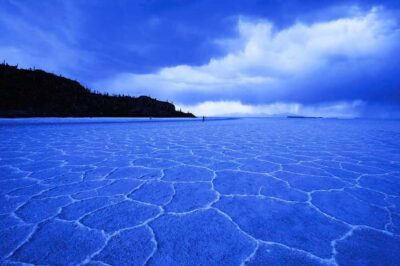
Uyuni Salt Flats and San Pedro de Atacama 3-Day Tour
Read our review →
4-Day Trip to San Pedro de Atacama w/Salt Flats
Read our review →Browse the lists this tour appears in